TGV High-Speed Train Guide
If you travel by train across France, you will most likely do so on a high-speed TGV service. TGV is an acronym for Train à Grande Vitesse, which simply means high-speed train in French.
TGV services are the most premium trains in France, combining speed and comfort. Capable of reaching speeds of up to 320 kilometres per hour (199 mph), they are among the fastest trains in Europe. For many city-centre to city-centre journeys, travelling by TGV is usually quicker than flying, as there is none of the check-in and early arrival hassle associated with airports, which are often located outside the city.
This guide provides everything you need to know about TGV high-speed trains in France, including the different types of services and the facilities available on board.
Different types of TGV services
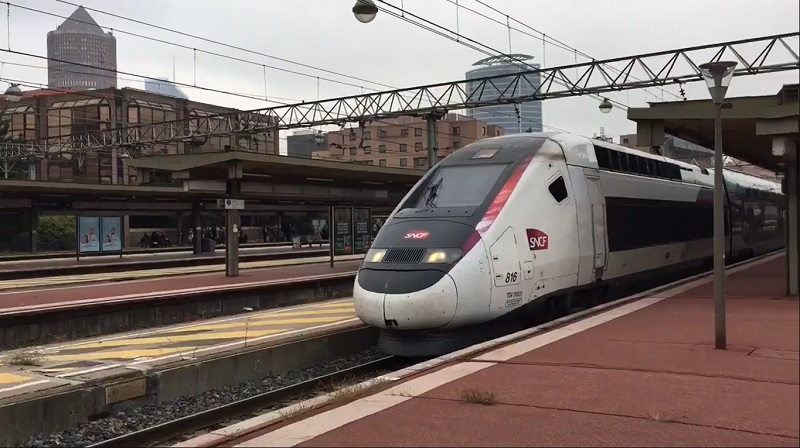
Although historically all high-speed trains in France were classified as TGV services, the French national railway company SNCF now uses different names for its high-speed services:
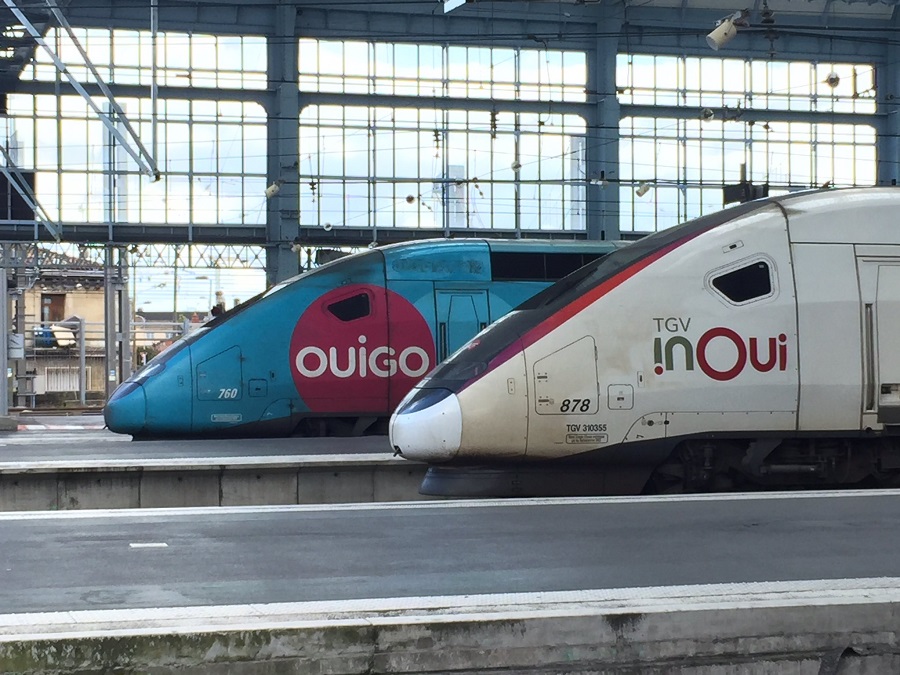
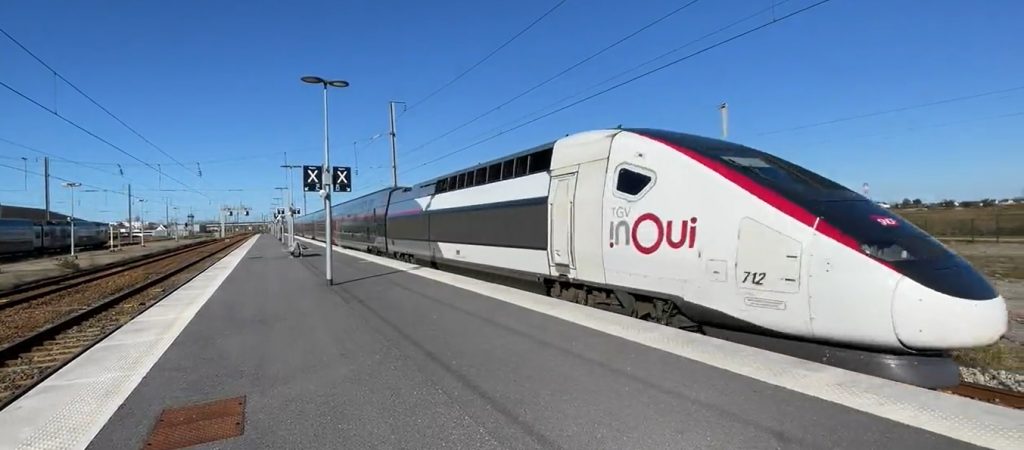
- TGV inOui is the standard high-speed service operated by SNCF and the most common one you will encounter in France.
- Ouigo is SNCF’s low-cost TGV service.
- TGV Lyria trains are high-speed TGV services running from Paris to destinations in Switzerland, such as Basel, Geneva, Lausanne and Zurich.
While inOui high-speed services offer both first and second class and include a café-bar coach, Ouigo trains provide second class only and have no bar. Some Ouigo services also use secondary stations or operate at less convenient times.
In practice, TGV Lyria services are very similar to standard inOui trains, the main differences being the branding and their joint operation with Swiss Railways.
Baggage rules
It is important to keep in mind the baggage restrictions when travelling on a TGV train, as they differ from most other trains in Europe, where you can usually take as much luggage as you can carry. This is especially true on low-cost Ouigo TGV services, which have much stricter luggage rules, similar to low-cost airlines, and staff often enforce them during boarding.
On inOui TGV trains, you may take either up to two suitcases plus one item of hand luggage, or one suitcase plus one special item of luggage and one item of hand luggage. A special item refers to a foldable bicycle, a large musical instrument, a pair of skis, wheelchair, or similar items. Bikes, musical instruments, snowboards and skis must be carried in a labelled cover. Hand luggage may measure a maximum of 40 cm × 30 cm × 15 cm, while suitcases may measure up to 70 cm × 90 cm × 50 cm. A special luggage item can measure a maximum of 90 x 130 x 50 cm.
On Ouigo TGV trains, a train ticket includes strictly one item of cabin luggage (55 x 35 x 25 cm) with no weight limit and one item of hand luggage (40 x 30 x 15 cm). A fee applies for an additional luggage piece.
Full details about luggage restrictions can be found on the SNCF website.
Travel classes
On French inOui TGV trains, both first and second class are available, while Ouigo TGV trains offer second class only.
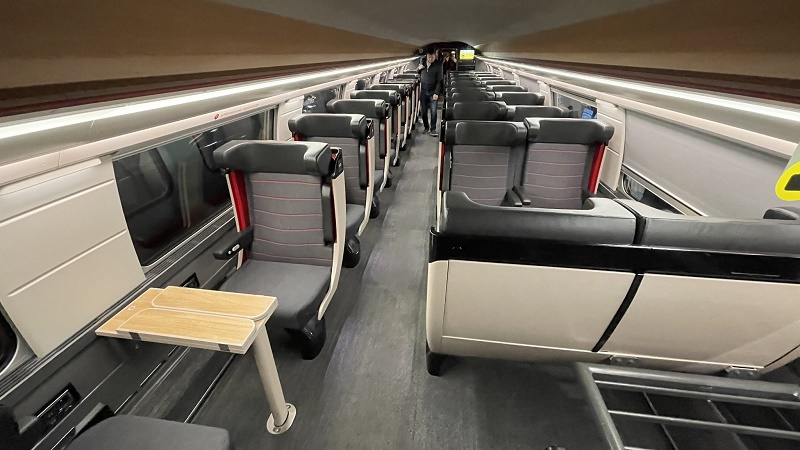
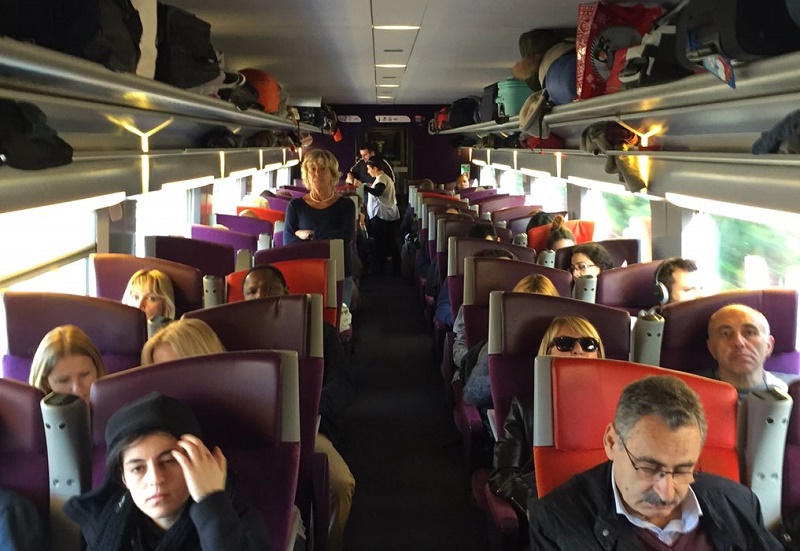
Second class seating on TGV trains is arranged in a 2+2 configuration, either as two-abreast seats with fold-out tables or in bays of four seats around a fixed table. First class seating is arranged in a 1+2 configuration. Seats in first class may be solo, pairs next to each other, pairs opposite each other around a fixed table, or in a bay of four.
Regardless of class, all French TGV trains provide power sockets at every seat and are equipped with Wi-Fi.
TGV trains in France require compulsory seat reservations. When you purchase your ticket, a reserved seat is automatically included. Most TGV services in France are operated by double-deck high-speed trains. You can generally choose whether to sit on the upper or lower deck when booking your ticket.
Dining car
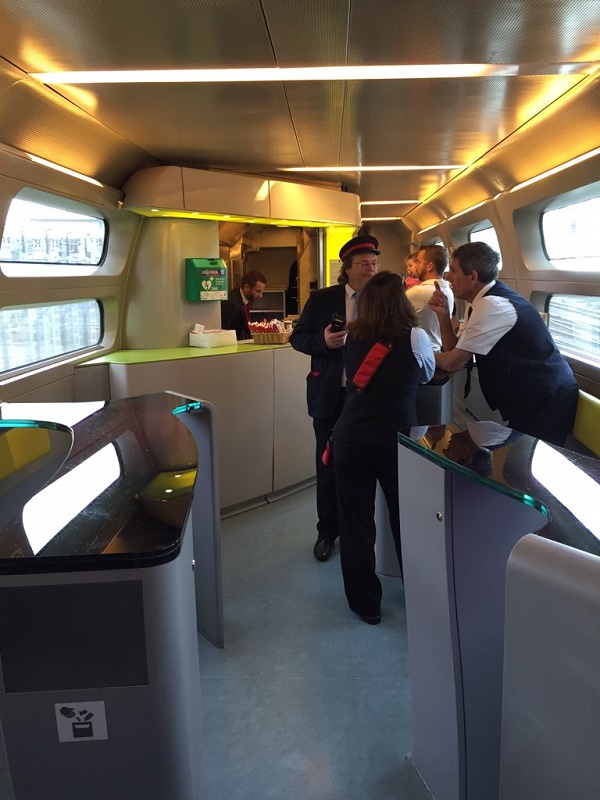
On inOui TGV high-speed trains, as well as on TGV Lyria services, you will find a café-bar coach. Here you can purchase a variety of hot and cold drinks, including beer and wine, along with snacks and light meals.
These café-bars have standing tables only and are not full dining cars like those found on some other European trains. Although the food is microwaved or heated in an oven rather than freshly prepared, the quality is generally decent. Of course, you are always free to bring your own snacks and drinks on board TGV trains.
High-speed railway lines in France
France has several high-speed rail lines, known as LGV (Lignes à Grande Vitesse, or high-speed lines). These are the main lines:
- LGV Sud-Est – links Paris with Lyon
- LGV Rhône-Alpes – running from Lyon to Valence
- LGV Méditerranée – linking Valence southwards to Avignon and Marseille
- LGV Atlantique – connecting Paris with western France, up to Bordeaux
- LGV Est – running east from Paris to Strasbourg
- LGV Nord – connecting Paris with Lille in the north of France, with branches to the Channel Tunnel and Belgium
- LGV Rhin-Rhône – runs from Dijon to Mulhouse, connecting eastern France with the Rhine region and Switzerland
- LGV Bretagne-Pays de la Loire – links Paris with Le Mans and Rennes
TGV trains are not limited to these LGV lines, as many also operate on conventional railway lines to reach dozens of other destinations across the country. For example, although the LGV Bretagne-Pays de la Loire ends at Rennes, TGV trains continue from there on conventional railway lines to reach destinations throughout Brittany.
TGV trains can only reach their maximum speeds on the dedicated high-speed lines. As a result, your train may travel at up to 300 kilometres per hour on one of these lines but be limited to around 100 kilometres per hour when running on conventional tracks.
International TGV services
Although the majority of TGV services operate domestically within France, a number of TGV trains also run to neighbouring countries.
Besides the previously mentioned TGV Lyria service between France and Switzerland, there are also TGV trains connecting France with Spain, Italy, Germany, Luxembourg, Belgium, and the Netherlands. In fact, Eurostar, which links Paris with London, Brussels, Amsterdam, and Cologne, is essentially a TGV service as well.
Book your French TGV train online
A reliable website for booking French TGV high-speed train tickets is Omio.
One of the main advantages of using Omio is that a single search allows you to compare trains from all the different railway operators. This means you will see not only SNCF trains, including inOui and low-cost Ouigo services, but also trains from other operators. This is particularly useful when booking international train tickets to or from France.
Within a single search, you can compare prices and departure times, check ticket conditions such as whether a fare is refundable or changeable, and book your tickets online.
Use the search tool below to find the best train connection for your next rail journey in France! Note that tickets for French trains can sell out in advance, especially so around national holidays or in the busy summer season. Prices are generally lowest when booked in advance and when travelling on off-peak services on less busy days.
Interrail and Eurail on French TGV trains
Using a global Interrail or Eurail pass for unlimited train travel across Europe, or a rail pass valid for France only, can be highly worthwhile.
You cannot simply board a TGV train with an Interrail or Eurail pass, as a seat reservation is required in combination with your rail pass. If you are travelling with an Interrail or Eurail pass, you therefore must make a special passholder reservation, which on some services may be limited by quota.
In our guide on how to make Interrail and Eurail passholder reservations, you can learn how to do this.
Note that Interrail and Eurail passes are valid only on inOui TGV trains in France and cannot be used on low-cost Ouigo services. They are, however, valid on TGV Lyria and Eurostar services.