EuroCity Train Guide
If you are travelling across central Europe by train, you are likely to come across EuroCity trains on your rail itinerary.
EuroCity trains – abbreviated as EC in online timetables and on departure boards – are essentially international InterCity services that connect different European countries, hence their name.
In this guide, I will explain everything you need to know about travelling on EuroCity trains across Europe, including where you can find them and what you can expect on board.
About EuroCity trains
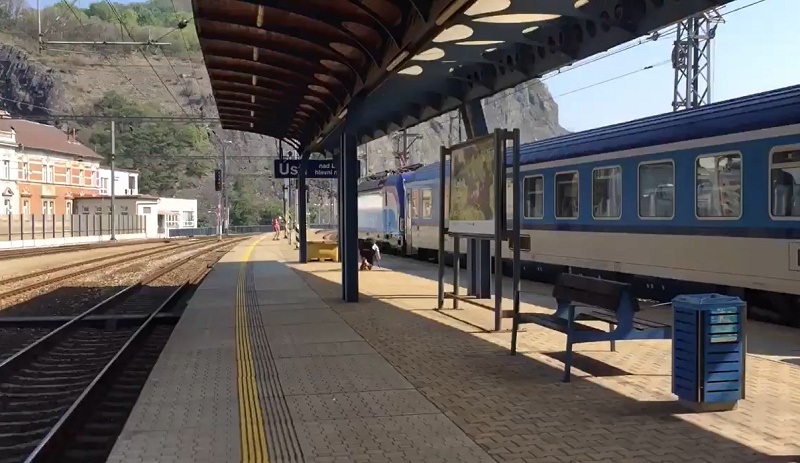
EuroCity trains are among the most premium services you can find on the European railway network. Although they are usually not as fast as high-speed trains such as the German ICE or the Austrian Railjet, they are nevertheless high-quality services, often using the best conventional rolling stock available in the countries in which they operate.
The EuroCity category is most common in Central European countries such as Austria, the Czech Republic, Germany, Hungary, Poland, Slovakia, and Switzerland, although these international trains also operate in Italy, Belgium, the Netherlands, and Denmark.
Rolling stock and travel classes
Most EuroCity trains you will come across in Europe are conventional, locomotive-hauled services, although there are a few notable exceptions, such as the modern EMU (electric multiple unit) trainsets linking Amsterdam with Brussels.
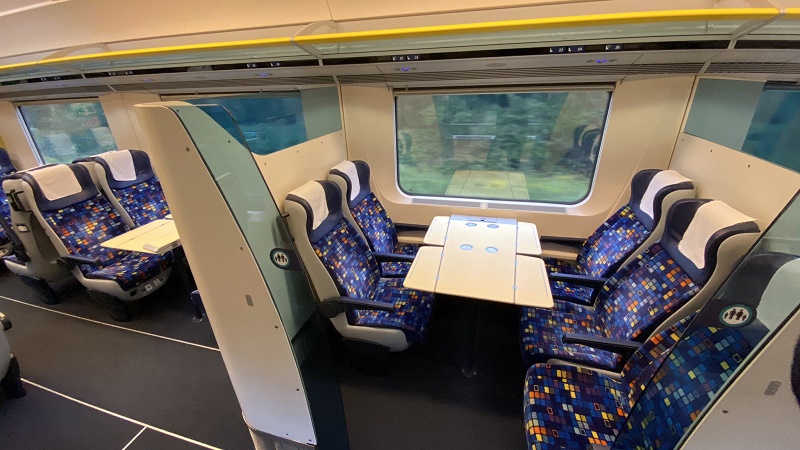
Travel classes on EuroCity trains are straightforward, as they follow the standard European system of first and second class. Depending on the country you are travelling in and the specific service you are using, seating may be arranged in six-seat compartment coaches or in open-plan carriages with saloon-style seating. If a train offers both options, you can often select your seating preference when booking online.
The actual coaches used on EuroCity services vary widely in terms of quality and comfort and largely depend on the operator and the specific train you are travelling on. Passenger coaches can be either modern or older, as well as highly comfortable or somewhat cramped, and newer does not always mean better in this respect.
While modern coaches typically offer power sockets and often Wi-Fi, older coaches can sometimes provide more comfortable seating if they are well maintained.
In addition, many EuroCity trains use a wide mix of rolling stock. For example, the EuroCity Metropolitan service, which links Budapest with Bratislava, Brno, and Prague, may use Hungarian, Slovak, or – most commonly – Czech coaches.
Dining car
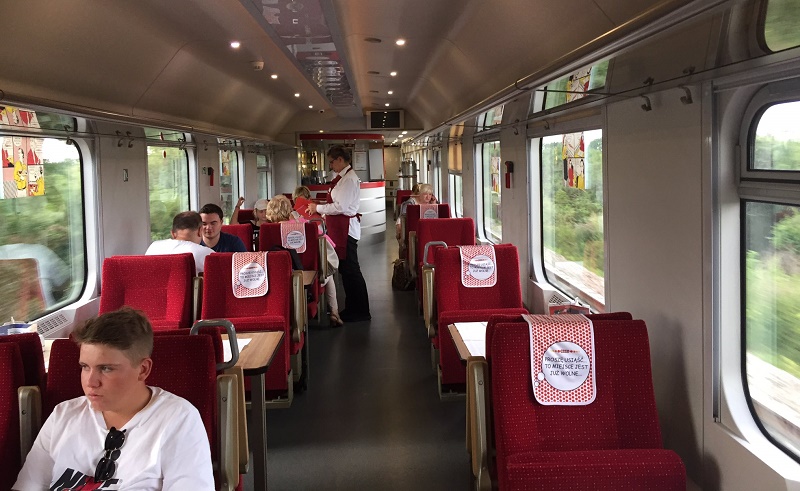
EuroCity trains often include dining cars, which is particularly common in Austria, the Czech Republic, and Poland. However, whether your specific service has a dining car depends on the exact train you are travelling on, so it is wise to do some research in advance. You can check with the train operator, consult reliable online sources such as the Deutsche Bahn timetables and Vagonweb, or look at recent reviews on Google or YouTube to see what to expect.
You are always free to bring your own food and drinks on board a EuroCity train and consume them at your seat. This also includes alcoholic beverages – with the exception of Poland, where consuming your own alcohol on trains is not permitted.
Even if your train is scheduled to include a dining car, it is still sensible to bring some water and small snacks with you, as the dining car may not be attached to your particular departure or may offer only a limited service for various reasons, which can occasionally happen.
Named trains
Many EuroCity trains are so-called named services and have become household names on the pan-European railway network.
For example, the EuroCity service Báthory operates between Budapest and Warsaw, the Emona runs from Vienna to Ljubljana, while the EuroCity Berliner connects Berlin and Prague.
Especially in Central Europe, there is a long tradition of naming EuroCity trains. Some of these named services have been operating for many decades, others are more recent introductions, while unfortunately some well-known train names have since been discontinued.
Book EuroCity trains online
If you want to book EuroCity trains – or any other rail service, whether a regular long-distance or high-speed train – online, you can use the booking platform Omio.
Omio allows you to book trains from almost all operators in Central Europe and compare prices between them. This means you do not have to search the websites of individual national or private operators, as all available train connections appear in a single search.
Use the search tool above to find the best connection for your European rail journey.